
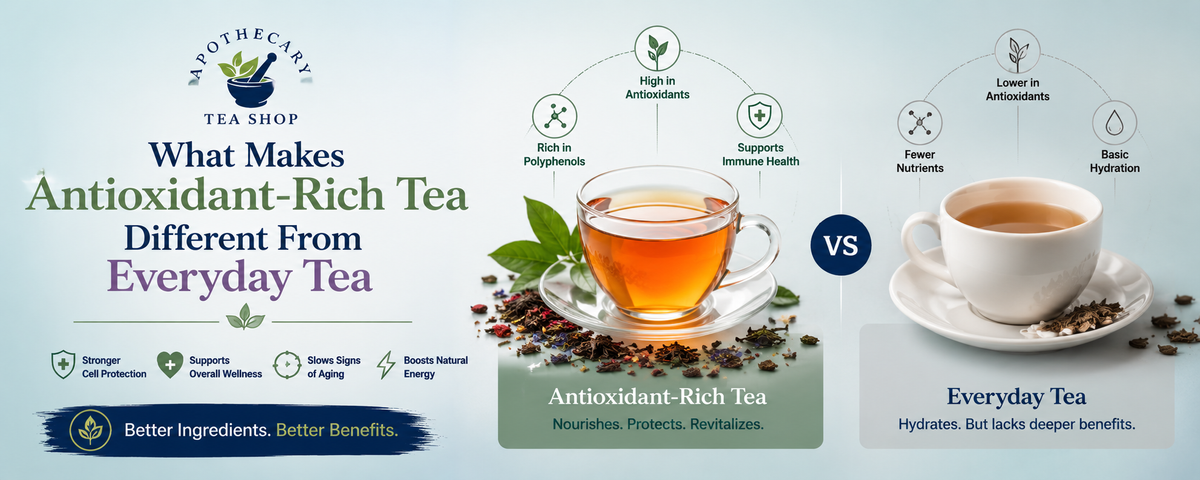
What Makes Antioxidant Rich Tea Different From Everyday Tea
Key Takeaways
Not all tea contains the same antioxidant load, processing, sourcing, and formulation determine what you actually get
Everyday tea provides some antioxidants; antioxidant-rich tea is formulated to deliver a measurable, targeted dose
Key compounds like catechins, Resveratrol, and NR are either absent or negligible in standard tea bags
Antioxidants in functional tea work at the cellular level, specifically in supporting mitochondrial health and fighting oxidative stress
The Gap Between "Has Antioxidants" and "Antioxidant-Rich"
Every true tea, black, green, white, oolong, comes from the Camellia sinensis plant and contains polyphenols. Polyphenols are antioxidants. So technically, your standard teabag does have antioxidants.
The question is how many, which types, and whether they survive the processing chain intact enough to do anything useful in your body.
A tea bag that's been machine-processed, blended with lower-grade leaves, and packaged months before you brew it has a fraction of the antioxidant activity it started with. That's not a marketing claim, oxidation during processing is well-documented and measurable.
An antioxidant rich tea starts with higher-quality source material, uses processing methods that preserve polyphenol integrity, and often adds complementary compounds that amplify the body's antioxidant response.
What Antioxidants Actually Do in the Body
Free radicals are unstable molecules produced during normal metabolic activity, and in higher quantities from stress, pollution, poor sleep, and processed food. Left unchecked, they damage cells, proteins, and DNA. That process is called oxidative stress, and it's directly linked to accelerated aging and chronic disease risk.
Antioxidants neutralize free radicals before they cause damage. The body produces some antioxidants on its own. Dietary antioxidants, from food, supplements, and functional beverages, extend that defense.
This is where the distinction between natural tea and a purpose-built antioxidant formula matters. A cup of ordinary tea might take the edge off your free radical load. A properly formulated wellness tea targets oxidative stress at the cellular level, specifically within the mitochondria, which are both the primary site of free radical production and the engine of cellular energy.
How Everyday Tea Compares
Standard black tea contains theaflavins and thearubigins, antioxidant compounds formed during the oxidation process that gives black tea its color and flavor. Green tea retains catechins, particularly EGCG (epigallocatechin gallate), because it skips the oxidation step.
Both provide genuine antioxidant value. Neither is formulated to maximize it.
The issues with everyday tea come down to three things: grade of leaf, processing method, and what isn't in it. A commodity tea blend uses fannings and dust, the smallest, lowest-grade particles left after higher-grade leaves are sorted out. These have less surface area in good leaf tissue and more surface area exposed to oxygen during storage. By the time they reach your cup, much of their polyphenol content has degraded.
Beyond that, standard tea contains no added compounds targeting mitochondrial function, cellular repair, or healthy aging. It's a beverage, not a functional supplement.
What Makes Antioxidant-Rich Tea Different
A genuine antioxidant rich tea differs in source quality, formulation approach, and ingredient profile.
Source quality. Higher-grade whole or broken leaf teas retain more of their natural polyphenol content. The difference shows up in ORAC values, flavor complexity, and how the body responds.
Formulation. Some functional teas add concentrated plant extracts, green tea extract standardized to a specific catechin percentage, for example, rather than relying on whatever antioxidants survive a standard brew.
Complementary compounds. This is where natural tea and functional antioxidant tea diverge most sharply. Compounds like Resveratrol (a polyphenol found in grape skins, known for activating longevity pathways) and NR (Nicotinamide Riboside, a precursor to NAD+ which is critical for mitochondrial function) don't appear in any standard tea. They require deliberate formulation.
Longevitea from Apothecary Tea Shop is built on exactly this model: black tea as the antioxidant base, with Resveratrol and NR added to address cellular aging mechanisms that standard tea simply doesn't touch. It's the difference between a drink that has antioxidants and one engineered around them.
Key Compounds to Look For
If you're evaluating antioxidant rich teas, these are the compounds that separate functional products from marketing:
Catechins (especially EGCG). Found in green tea. The most-studied tea antioxidant with documented effects on oxidative stress, metabolism, and cardiovascular markers. Look for products that specify catechin content, not just "green tea extract."
Theaflavins. The primary antioxidants in black tea. Less studied than catechins but associated with cholesterol management and anti-inflammatory effects. Present in quality black tea; degraded significantly in low-grade commercial blends.
Resveratrol. A polyphenolic compound that activates sirtuins, proteins involved in cellular repair and longevity. Found in red wine in tiny amounts; functional supplements deliver it at meaningful doses.
NR (Nicotinamide Riboside). Not an antioxidant itself, but a critical cofactor for mitochondrial function. Supports the body's own antioxidant enzyme systems by restoring NAD+ levels.
Polyphenol diversity. No single compound does everything. A tea formulated with a range of polyphenols, from the base tea plus botanical additions, gives your body more tools to work with.
Who Should Consider Switching
Everyday tea is fine if you're drinking it for the ritual, the flavor, or mild caffeine. There's nothing wrong with it.
The case for switching to a targeted antioxidant rich tea is strongest when you're actively trying to address something specific: low energy, signs of accelerated aging, interest in supporting cellular health long-term, or recovery from periods of high physical or cognitive stress.
Anyone in their 40s or beyond is dealing with measurably declining NAD+ levels and reduced mitochondrial efficiency. Standard tea doesn't address that. A wellness tea formulated with mitochondria-supporting compounds does.
Athletes and people under high oxidative load, from training, stress, or environmental exposure, produce more free radicals than average. A higher antioxidant intake is directly relevant to that, and a functional tea delivers it in a practical, daily format.
FAQ
Q: If I drink green tea every day, am I already getting enough antioxidants?
Green tea is a solid source of catechins, particularly EGCG. You're getting real antioxidant benefits. What everyday green tea won't give you is the Resveratrol or NR that target mitochondrial function specifically, those that require formulated supplementation. Think of daily green tea as a good foundation, not a complete strategy.
Q: Does steeping time or water temperature affect antioxidant levels?
Yes, significantly. Water that's too hot degrades catechins, especially EGCG. The standard guidance for green tea is 70–80°C rather than boiling. Steeping too long increases bitterness and doesn't add a meaningful antioxidant benefit after the first 2–3 minutes. Longevitea sidesteps this entirely, as an instant mix, the formulation is stable and delivers consistent potency every time.
Q: How is Longevitea different from just buying a green tea extract supplement?
A green tea extract capsule targets catechins. Longevitea combines black tea antioxidants with Resveratrol and NR, compounds that work through different mechanisms, including NAD+ restoration and sirtuin activation. The combination is more comprehensive than any single-ingredient supplement, and it's delivered in a format most people actually stick to daily.
Q: Are the antioxidants in tea enough on their own for cellular health?
Tea antioxidants are one input among several. Sleep, diet quality, stress management, and physical activity all affect your oxidative stress load. A well-formulated antioxidant tea supports cellular health as part of a broader approach, it's not a replacement for the fundamentals, but it adds a meaningful layer that standard nutrition often misses.
Q: How long before I notice any difference from switching to an antioxidant-rich tea?
Cellular-level changes, particularly in mitochondrial function, aren't always immediately perceptible. Most people report improved energy and mental clarity within a few weeks of consistent use. Longevity-oriented benefits like reduced oxidative damage accumulate over months. Consistency matters more than any single serving.
Conclusion
The gap between everyday tea and a properly formulated antioxidant rich tea is not marketing, it's chemistry. Leaf grade, processing, and ingredient profile determine whether you're getting a pleasant beverage or a functional tool for cellular health.
Standard tea has antioxidants. Apothecary Tea Shop's Longevitea is built around them, combining black tea's natural polyphenol base with Resveratrol and NR to address the mechanisms behind aging and oxidative stress that a supermarket teabag was never designed to touch.